It is apparent that most of society is currently experiencing the Information Age, or as most of us know it, where electronics and the Internet rule our daily lives. However, has anyone taken a real minutue or two in thinking how much technology has accomplished for us?
Currently, we enjoy several activities, that otherwise would have been considered luxuries in past times, every day. These amenities are things like cell phone usage, grocery shopping, home entertainment, educational assistance, etc. We can't deny that our society would remotely be the same without technology, or electronics, in the picture.
For instance, technology allows for advancements in the medical field. There are current attempts of finding the cure to cancer and other serious illness, a well known challenge faced by former scientists who introduced already known vaccines/solutions to previous illnesses. In the educational field, computers allow us to further manage and assimilate the information required for us to learn the material effectively, fast, and above all, at our own pace. Computers have been revolutionary to the human race. Nonetheless, there a side of technology that I would like to further discuss.
I have always said that technology is a two-fold sword. Yes, it has equipped humanity with great power over the future. We can certainly have control over what happens in the future, due to the rapid nature of technology. In fact, technology duplicates every two years. These means that if there were two technologies introduced this year, there would be four completely new technologies the next. At first glance, one can identify this trend as Moore's Law. Technology has the tendency of growing at an exponential rate. Now, what does this mean? Well, certainly 2, 4, and 8 technologies for years 1, 2, and 3, respectively, are less than a handful of technologies, so what's the problem? Well, it certainly seems that at first, there's nothing to be worried about, however, to the viewer's surprise, this number begins growing very rapidly!
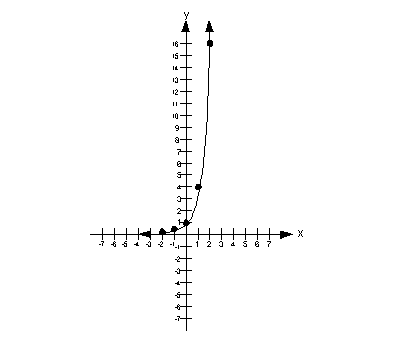
Now, what does this mean for humanity? Well, speaking for myself, as a computer scientists nonetheless, the technology I am having to deal with, for instance, is extremely exhaustive already, and I have not completely covered my studies in its entirety. I am not saying this is a way for me to cope with a field which is overwhelming, in contrary, I enjoy this science and above all enjoy learning more about it. However, it has been brought to my attention that the technologies that I am learning are quickly becoming deprecated. Technologies that were once in the grove, and in style, are obsolete within two years! This means that the new technologies would need to be adopted and applied thoroughly and regularly!
As sciences become more focused and less broad, we will see the surge of more specific technology in more concentrated fields, meaning that the number of technologies are essentially going to increase... For instance, new fields such as MIS, CIS, Bio-engineering, etc, require intense usage of technology for its research and advancement and above all its practice. Now, why does this really matter?
Well, we are certainly already reaching the point to where the average individual is experiencing something known as Information Overload. This is the situation where the individual is presented with too much information to the degree that they are no longer able reliable choices based on that data, or become emotionally numb. Due to information overload, more often than not, individuals lack response of such information, irrelevant of context.
I notable example is when one is searching for something in particular and they ask Google for assistance. A second nature comes into play where the individual simply scans for key words and bright colors in common areas of the screen where they expect their anticipated piece of information may be located. Such nature was developed, in this instance, because Google provides too many results for a single query of the internet. Of course, this is not at all bad for our user -- however due to such a practice the user has been required to learn the new habit of knowing how to scan the page quickly for keywords and specific factors that will allow them to make best use of their time and achieve the desirable result. (Of course the user need to learn how to weed out the unreliable results such as advertisements, scams, promotions, etc.)
There is a concept introduced by Ray Kurzweil called the [technological] Singularity. He talks about how technology is expanding so quickly and that soon, humanity may be faced with the problem of not being able to keep up with it. This problem, he states, is going to give us the final push for human/machine integration. In fact, as it has been stated by many other scientists, the powers of machine will soon exceed the capacity of the human mind and, soon, of the entire human population.
This episode really gives me the creeps. It also reminds me of the TED conference hosted by Juan Enriquez, where he talks about the subsequent specie of the homo-sapien-sapien, the homo evolutis. He claims that this new race will have the complete control over the evolution over its own specie and the species of others as well. Now, if you think about it, this should be within the grasp of "humanity" after reaching the point of [technological] singularity. Having achieved the interface between human and machine, several things will be able to occur. Humans will be able to assimilate the tremendous amount of information with a blink-of-an-eye (figuratively speaking of course), human downloads/uploads, unsurpassed AI, regulated human conditions, etc. Possibilities are truly endless. Another flashback I get is from the Anime Serial Experiments: Lain.
I was not really surprised with this anime with regards to the message that it intended to deliver. There are several, or I should say, paramount number of references to biblical passages, but nonetheless, all of which have to do with Existentialism, Individuality, and other related philosophies. Most of the ideas that were brought about by this anime, I had already visited, but one.

Serial Experiments Lain visits a world where Lain, the main character of the series is introduced to The Wired, a more advanced version of the Internet in our world. Lain is able to "hook" herself up to The Weird and navigate an entirely different world. [[Spoiler]] However to the audience's surprise Lain is completely software built and fully omnipresent in The Wired. Because of this omnipresence, the concept of a collective conscience is introduced in the anime. It is said, that whenever anyone hooks themselves to The Wired, their consciences become one with that of Lain's...[[End of Spoiler]]
Now the reason this spooks me is because due to the mere idea that if humanity ever achieves human/machine interaction at the most basic level of neuron with circuitry, the unanimous consciousness is more than a possibility, it will be an imminent reality. Now think about it, a place not bound by any physical means, one restricted only by one's imagination (of course I am taking many liberties here, but why not? Is it not humanities vision to have the perfect world? A Utopian world?). With this taking place in reality?....Wait reality? After than, everything is up to question, in fact, even this reality. I'd say it would be spiritual turmoil and ultimately human abandonment. There would no longer be the need for individuality or pleasure (since living in a utopian society would constitute no pain, there would exist nothing to offset pleasure...)
Now do you see the problem I have with technology?
Currently, we enjoy several activities, that otherwise would have been considered luxuries in past times, every day. These amenities are things like cell phone usage, grocery shopping, home entertainment, educational assistance, etc. We can't deny that our society would remotely be the same without technology, or electronics, in the picture.
For instance, technology allows for advancements in the medical field. There are current attempts of finding the cure to cancer and other serious illness, a well known challenge faced by former scientists who introduced already known vaccines/solutions to previous illnesses. In the educational field, computers allow us to further manage and assimilate the information required for us to learn the material effectively, fast, and above all, at our own pace. Computers have been revolutionary to the human race. Nonetheless, there a side of technology that I would like to further discuss.
I have always said that technology is a two-fold sword. Yes, it has equipped humanity with great power over the future. We can certainly have control over what happens in the future, due to the rapid nature of technology. In fact, technology duplicates every two years. These means that if there were two technologies introduced this year, there would be four completely new technologies the next. At first glance, one can identify this trend as Moore's Law. Technology has the tendency of growing at an exponential rate. Now, what does this mean? Well, certainly 2, 4, and 8 technologies for years 1, 2, and 3, respectively, are less than a handful of technologies, so what's the problem? Well, it certainly seems that at first, there's nothing to be worried about, however, to the viewer's surprise, this number begins growing very rapidly!
Now, what does this mean for humanity? Well, speaking for myself, as a computer scientists nonetheless, the technology I am having to deal with, for instance, is extremely exhaustive already, and I have not completely covered my studies in its entirety. I am not saying this is a way for me to cope with a field which is overwhelming, in contrary, I enjoy this science and above all enjoy learning more about it. However, it has been brought to my attention that the technologies that I am learning are quickly becoming deprecated. Technologies that were once in the grove, and in style, are obsolete within two years! This means that the new technologies would need to be adopted and applied thoroughly and regularly!
As sciences become more focused and less broad, we will see the surge of more specific technology in more concentrated fields, meaning that the number of technologies are essentially going to increase... For instance, new fields such as MIS, CIS, Bio-engineering, etc, require intense usage of technology for its research and advancement and above all its practice. Now, why does this really matter?
Well, we are certainly already reaching the point to where the average individual is experiencing something known as Information Overload. This is the situation where the individual is presented with too much information to the degree that they are no longer able reliable choices based on that data, or become emotionally numb. Due to information overload, more often than not, individuals lack response of such information, irrelevant of context.
I notable example is when one is searching for something in particular and they ask Google for assistance. A second nature comes into play where the individual simply scans for key words and bright colors in common areas of the screen where they expect their anticipated piece of information may be located. Such nature was developed, in this instance, because Google provides too many results for a single query of the internet. Of course, this is not at all bad for our user -- however due to such a practice the user has been required to learn the new habit of knowing how to scan the page quickly for keywords and specific factors that will allow them to make best use of their time and achieve the desirable result. (Of course the user need to learn how to weed out the unreliable results such as advertisements, scams, promotions, etc.)
There is a concept introduced by Ray Kurzweil called the [technological] Singularity. He talks about how technology is expanding so quickly and that soon, humanity may be faced with the problem of not being able to keep up with it. This problem, he states, is going to give us the final push for human/machine integration. In fact, as it has been stated by many other scientists, the powers of machine will soon exceed the capacity of the human mind and, soon, of the entire human population.
This episode really gives me the creeps. It also reminds me of the TED conference hosted by Juan Enriquez, where he talks about the subsequent specie of the homo-sapien-sapien, the homo evolutis. He claims that this new race will have the complete control over the evolution over its own specie and the species of others as well. Now, if you think about it, this should be within the grasp of "humanity" after reaching the point of [technological] singularity. Having achieved the interface between human and machine, several things will be able to occur. Humans will be able to assimilate the tremendous amount of information with a blink-of-an-eye (figuratively speaking of course), human downloads/uploads, unsurpassed AI, regulated human conditions, etc. Possibilities are truly endless. Another flashback I get is from the Anime Serial Experiments: Lain.
I was not really surprised with this anime with regards to the message that it intended to deliver. There are several, or I should say, paramount number of references to biblical passages, but nonetheless, all of which have to do with Existentialism, Individuality, and other related philosophies. Most of the ideas that were brought about by this anime, I had already visited, but one.
Serial Experiments Lain visits a world where Lain, the main character of the series is introduced to The Wired, a more advanced version of the Internet in our world. Lain is able to "hook" herself up to The Weird and navigate an entirely different world. [[Spoiler]] However to the audience's surprise Lain is completely software built and fully omnipresent in The Wired. Because of this omnipresence, the concept of a collective conscience is introduced in the anime. It is said, that whenever anyone hooks themselves to The Wired, their consciences become one with that of Lain's...[[End of Spoiler]]
Now the reason this spooks me is because due to the mere idea that if humanity ever achieves human/machine interaction at the most basic level of neuron with circuitry, the unanimous consciousness is more than a possibility, it will be an imminent reality. Now think about it, a place not bound by any physical means, one restricted only by one's imagination (of course I am taking many liberties here, but why not? Is it not humanities vision to have the perfect world? A Utopian world?). With this taking place in reality?....Wait reality? After than, everything is up to question, in fact, even this reality. I'd say it would be spiritual turmoil and ultimately human abandonment. There would no longer be the need for individuality or pleasure (since living in a utopian society would constitute no pain, there would exist nothing to offset pleasure...)
Now do you see the problem I have with technology?


(I thought I posted a comment here already...guess I'll have to write it all out again)
ReplyDeleteReading your post made me think more deeply about some of the things you have mentioned, namely Moore's law and the Utopian world.
1) Moore's law- this law can not hold indefinitely. Aside from the physical constraints (i.e. how small a transistor can get), developing technology takes resources. I worry that we are burning through what we have. Just like the human population exploded at the advent of agriculture, there's an upper limit based on what resources are available. Eventually, our unbounded rate of growth will overshoot its capacity, which will then cause all hell to break loose (maybe). I mention this because we may reach a point where it becomes too costly to invest in some forms of technology.
2) The utopia you have described: Reading this reminded me of those people in a perma-dream state from the movie, Inception. I can definitely see this happening and getting out of hand unless it is repressed very early. Even if it does effectively destroy our culture by removing the essential elements of pain and struggle, I feel that after a period we will restore things. A parallel to this may be the industrial revolution. Everyone was so excited about mass produced cheap goods that worker health was terrible and the environment wasnt respected at all. Now, we still have factories and stuff, but have regulations imposed on them and there are several efforts to prevent any abuse.
Aye, I neglected to cover the limitations of Moore's law. But looking at what you said, it reminds me of the Peak Oil problem we are having. If oil becomes more expensive, which it obviously is, then everything associated with oil will, in turn, be more expensive as well (which is practically everything). I personally don't like that future...seems too gloomy for me :/ Societal downfall...
ReplyDeleteWith regards to the Utopia, idk, Industrial Revolution made our lives much easier to live. But given it did not question the very essence of what is humanity and what is real and what is not. I do see society imposing restrictions and regulations to prevent unwanted consequences, however, wouldn't the moral foundations truly be shaken on the advent of this achievement by humanity? Ethics will certainly be up to question, and with technology still growing at an exponential rate, who knows...